Unifying business operations to help you save lives, time, and money
People Powered IoT
Strategic IoT partner delivering advanced technology and data insights to optimize your assets, your business, and your future.

Our fleet intelligence platform unites people, assets, and IoT device data together on a single platform to transform the way you do business.
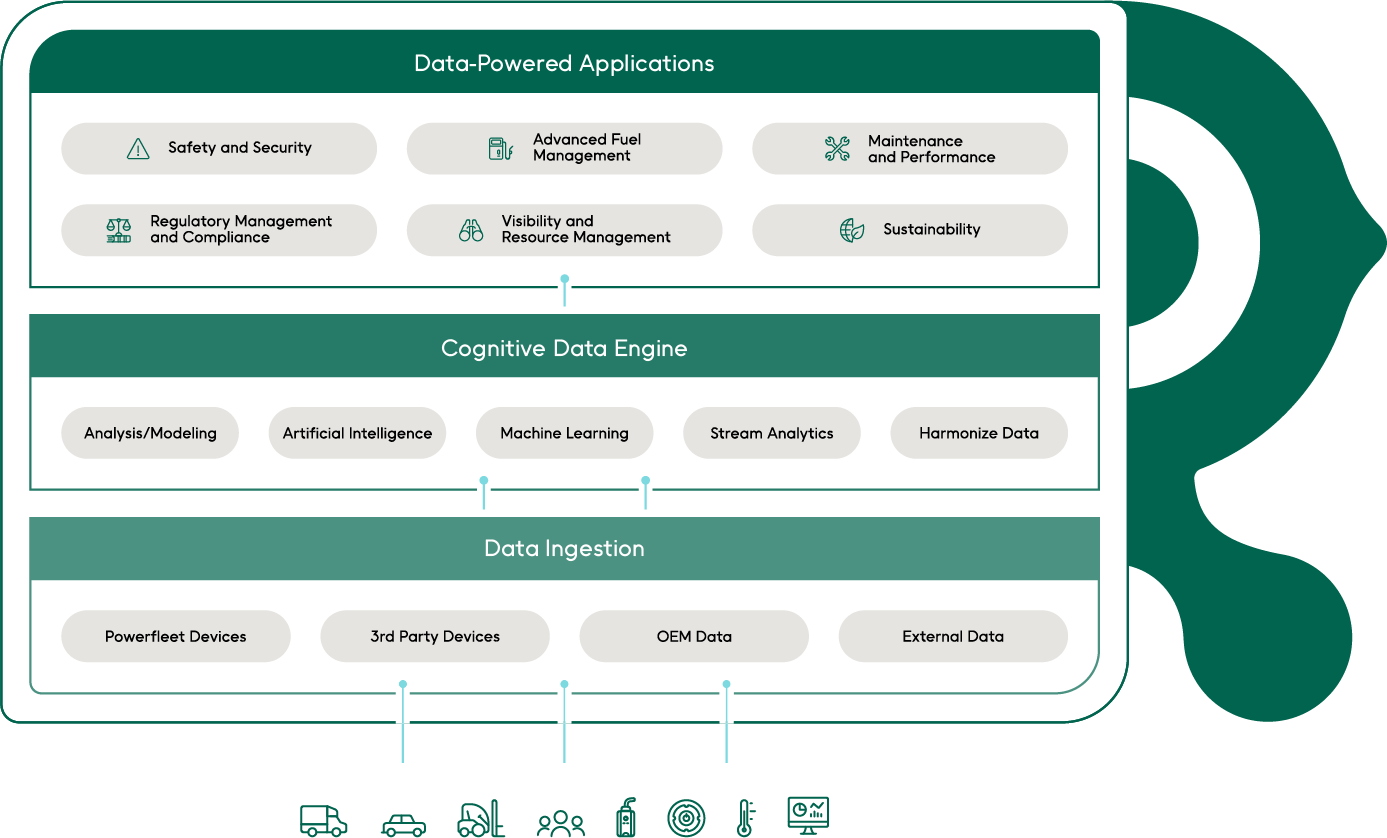
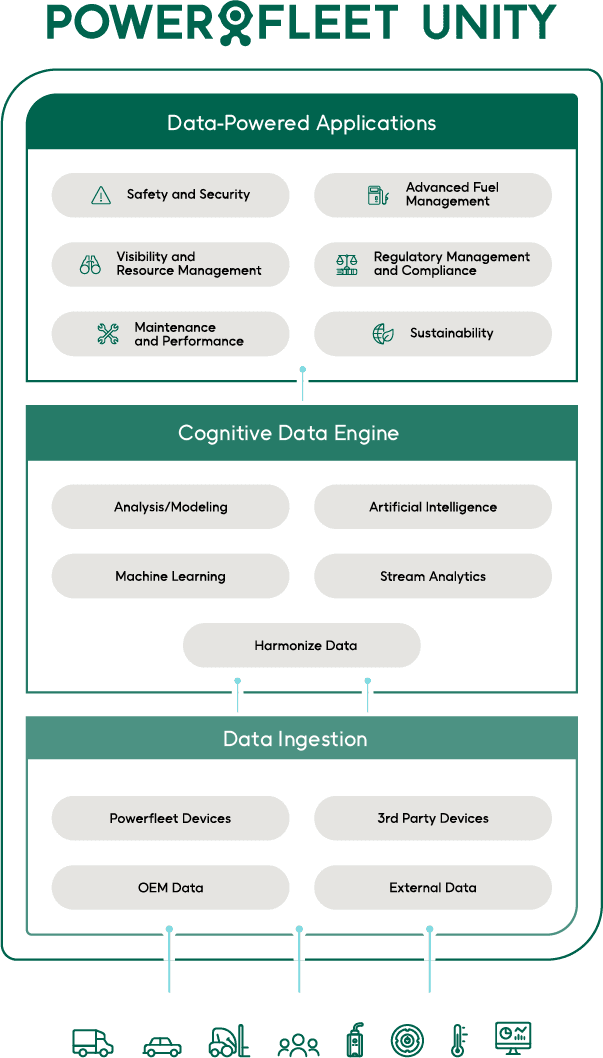

Use livestream data to enhance driver coaching and performance to reduce accidents on the road. In addition, use third-party data to help identify danger spots for your drivers and proactively work around them to further reduce risk.

Proactively manage fuel costs, avoid fuel theft, coach drivers based on driving behaviors, and achieve sustainability goals.

Reduce downtime, breakdowns, and manage your maintenance operations based on real-world usage and history to ensure you don’t over or under service assets to avoid unnecessary costs.

Automate compliance workflows, record keeping, and enable your drivers to focus on getting to their destinations safely and on time.

Analyze asset, vehicle, and people utilization to avoid costly rentals, reduce theft, and under-used resources to increase efficiency and ensure your team is where they are needed.

Advance your green agenda. Unity is ready to support your organization’s transition to electric vehicles (EV) with hundreds of EV data elements to optimize fleet planning, battery range, EV safety, and maintenance.
Kavak is a Mexican company that operates an online marketplace for used cars. Using connected cars and real-time data, they are reimagining maintenance, upselling, safety, and customer loyalty.
Moises Flores Botello, Kavak’s Chief Financial Officer, speaks about how valuable Kavak’s relationship with Powerfleet has been during the past four years.

What makes Powerfleet stand out has always been their responsiveness, creativity, problem-solving mindset to provide innovative solutions for our industry’s challenges and improvement opportunities
We have been working with Powerfleet since 2016 and consider them a critical partner. We like where they are going regarding a unified IoT perspective and look forward to using our data to drive deeper insights into our business.

Due to strong consumer feedback and efficiency we’ve seen in our workflow, we are dedicating additional resources to expand our Avis QuickPass offering. For those unfamiliar with this product, it enables our preferred customers upon arrival to select from a choice of vehicles on their phone, proceed directly to their car, and then utilize a unique QR code to exit via our automated Express Exit for a completely contactless experience.
Two years ago, we could buy a dry van trailer for $30,000 – today, they are $50,000. Some receivers use our trailers as an extension of their warehouse. One of our customers has 20-25 of our trailers at any given time. Powerfleet’s solution has allowed me to see when a trailer has been dropped for more than seven to ten days. Powerfleet’s solution lets us see where our trailers are at any time and enables better communication with our customers because we are armed with accurate data to hold them accountable.

This solution has more than helped cut costs and increase productivity and safety. The data and reports we receive provides our team with more knowledge than we ever knew possible.

For us, time was of the essence as we were on the verge of losing visibility on our newly acquired equipment when we initiated collaboration with Powerfleet. What we find impressive is Powerfleet’s ability to have implemented everything we wanted within a tight deadline, be it providing connectivity or the system reprogramming. This saved us a lot of trouble with potential idling of our equipment.
Powerfleet’s solutions gave us the tools we needed to run the most efficient—and profitable—trailer fleet. From finding lost trailers and right-sizing our trailer pools to reducing new trailer buys, our tracking system has added over $1 million to our bottom line.

Relying on conventional methods, such as safety trainings and conversations, isn’t enough. Working with Powerfleet allows us to elevate our safety standards, reduce costs, increase longevity of our vehicles, and help the environment with better fuel consumption.

Powerfleet’s intelligent solution complements our approach to offering the highest quality of work to our customers and helps our employees efficiently and safely do their job.

123 Tice Blvd. Suite 101
Woodcliff Lake, NJ 07677
©2024 Powerfleet. All Rights Reserved
Powerfleet to Host Virtual Analyst and Investor Fireside Chat on April 30, 2024
WOODCLIFF LAKE, N.J., April 16, 2024 – Powerfleet, Inc. (Nasdaq: PWFL) will host a virtual fireside chat for analysts and shareholders 30…
Powerfleet Selected as an Artificial Intelligence Excellence Awards Finalist
Unity Platform Celebrated for its Innovative AIoT Capabilities WOODCLIFF LAKE, NJ – April 9, 2024 – Powerfleet, Inc. (Nasdaq: PWFL)…
Powerfleet and MiX Telematics Close Business Combination, Creating New Top-Tier Global AIoT SaaS Provider
A Scaled Day-One Business with Total Revenue of $284 Million, Including $215 Million of Recurring High-Margin SaaS Revenues and Combined…